Every marketing budget conversation eventually comes down to one question:
How do I spend my next dollar?
Across TV, paid search, social media, email, out-of-home, radio, programmatic display, and influencer campaigns, where does the next dollar generate the most return?
Most businessed resort to intuition, budget inertia, and platform-reported metrics. However, platform metrics are not neutral, they each attribute conversions to themselves using self-serving models that overcount their contribution
Media Mix Modeling (MMM) is the systematic and statistically rigorous alternative. This post explains what it is, how it works, which tools exist, and why it matters
Marketing Mix Modeling (MMM) vs Media Mix Modeling (mMM)
Before anything else, let us clear up a naming confusion that trips most of us
Marketing Mix Modeling (MMM) is the broader discipline. It accounts for every business factor driving outcomes from pricing changes, product launches, promotions, distribution shifts, macroeconomic conditions, competitive activity, and seasonality, in addition to advertising spend. It follows the classic 4 Ps framework: Product, Price, Place, and Promotion.
Media Mix Modeling (mMM) is a focused subset of MMM. It zeroes in specifically on paid advertising channels. How your ad spend across Google, Meta, TikTok, display, programmatic, and other media drives your KPI. It is built for the question: across all my paid channels, where is the return actually coming from?
| Marketing Mix Modeling | Media Mix Modeling | |
|---|---|---|
| Scope | All business factors | Paid advertising channels only |
| Includes pricing? | Yes | Typically no |
| Includes seasonality? | Yes | Sometimes, as a control variable |
| Includes competitor activity? | Yes | Rarely |
| Typical user | Enterprise, brand marketers | Performance agencies, DTC brands |
| Risk of narrow focus | Low | Can miss broader business drivers |
This blog will focus primarily on Media Mix Modeling (mMM), the version most relevant to performance marketing agencies. Whenever the broader MMM framework is referenced, it will be clearly stated.
Attribution vs mMM: The Football Analogy
An easy way to understand what Media Mix Modeling (mMM) does differently is to contrast it with attribution, the measurement approach most agencies currently use
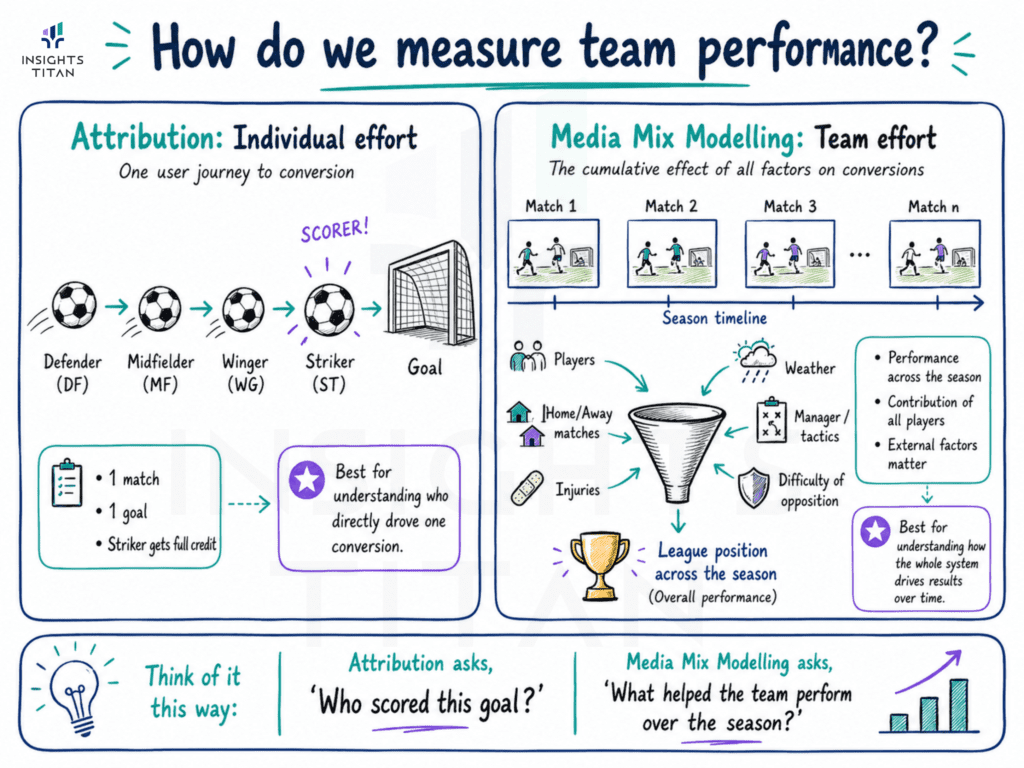
Attribution asks: “Who scored the goal?”
Think of one football match. A team scores, and the striker gets the credit. But the goal may have started with a defender winning the ball, a midfielder making the key pass, and a winger creating the space.
That is how attribution works. Last-touch attribution gives credit to the final ad or touchpoint before someone converts. Multi-touch attribution spreads the credit across the journey. But both are still focused on one user, one journey, and one conversion.
MMM asks: “What helped the team win over the season?”
Now, let’s zoom out. A team does not win the league because of one goal or one player, it wins because of many factors like: tactics, clean sheets, squad depth, injuries, fixtures, transfers, and player fitness.
Media Mix Modeling works the same way, it looks beyond individual customer journeys and studies the overall performance across weeks or months. It helps you understand how different factors, such as TV spend, paid social, promotions, competitor activity, and seasonality, contributed to revenue.
| Attribution | Media Mix Modeling (mMM) | |
|---|---|---|
| The question it answers | Who drove this conversion? | What drove our results over time? |
| Unit of analysis | Individual user journey | Aggregate performance across time |
| Time horizon | Single session or short window | Weeks, months, seasons |
| Data source | Platform pixels, cookies, user IDs | Your own sales and spend data |
| Platform bias | High | Low |
| Best used for | Campaign-level optimisation | Strategic budget allocation |
Neither approach is universally better. Attribution is useful for campaign-level optimisation. MMM is the right tool for questions like: across all our spend, where is the return actually coming from?
Questions MMM Is Best Built to Answer
Every well-implemented MMM is designed to answer three operational questions:
- What is the ROI and contribution from each of our marketing channels?
- What is the response curve for each channel (how does impact change as spend increases or decreases?)
- Based on these findings, how should we allocate our future budget (to maximise our business outcome?)
The first tells you where your money has been effective. The second tells you whether you are in the efficient part of the spend curve or already in diminishing returns. The third translates findings into a budget recommendation.
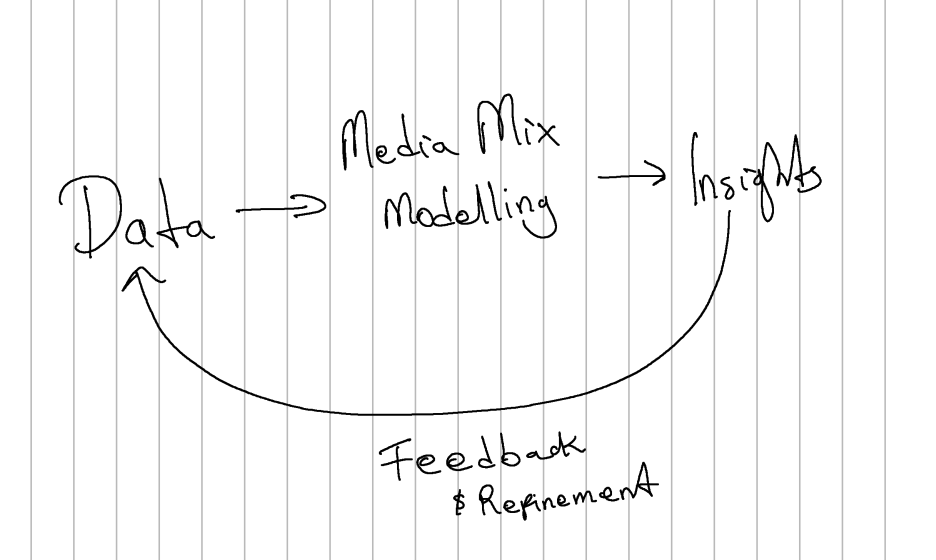
Together, they form a closed loop: measure, understand, refine, re-measure.
What You Can Do With mMM Results
Channel effectiveness ranking – Understand which channels are driving acquisition and which are riding the success of channels doing the heavy lifting
Budget optimisation – Reallocate spend across channels to maximise your KPI at a given budget. The model guides you on the optimal allocation given observed response curves
Saturation analysis – Determine when a channel is oversaturated, and additional spend generates zero marginal returns
ROI forecasting – Simulate different spending scenarios before committing
Synergy detection – Identify cross-channel multiplier effects, like TV awareness often lifts paid search conversion rates. mMM can detect and quantify this
Choosing Your mMM Tool
Three open-source frameworks dominate the MMM landscape. All three can be used to build Media Mix Models (mMM), and they differ significantly in flexibility and statistical approach
| Google Meridian | Meta Robyn | PyMC-Marketing | |
|---|---|---|---|
| Language | Python | R | Python |
| Statistical approach | Bayesian | Ridge regression / traditional ML | Bayesian, most flexible |
| Best for | Geo modeling, Google Ads integration | R teams, simpler setup, faster MMM adoption | Complex models, custom terms, production pipelines |
| Flexibility | Moderate | Low | High |
| Budget optimizer | Yes | Yes | Yes |
| MLflow integration | Yes | No | Yes |
| Consulting support | Third-party agency | Third-party agency | Provided by authors / PyMC Labs |
Closing
Media Mix Modeling is not a silver bullet. It requires good data, proper model specification, and people who can interpret results and translate them into decisions.
But when implemented properly, MMM answers questions that no other tool can. It cuts through platform bias, captures carryover effects, quantifies diminishing returns, and translates historical patterns into forward-looking budget recommendations. It is the only methodology that gives you a defensible, holistic view of what is actually driving your business.
The tools Google Meridian, Robyn, and PyMC-Marketing are all open source and more accessible than they have ever been
Build your data system first, then the model becomes an asset
Want to know where your next marketing dollar should go? Book a free Media Mix Modeling consultation