For proper data management, we need to organize our data to keep a clean data ecosystem and make data decisions more efficient and easy to find. The Medallion architecture does just that, it’s a data design pattern that organizes data into layers to progressively improve its quality, structure, and usability through transformation.
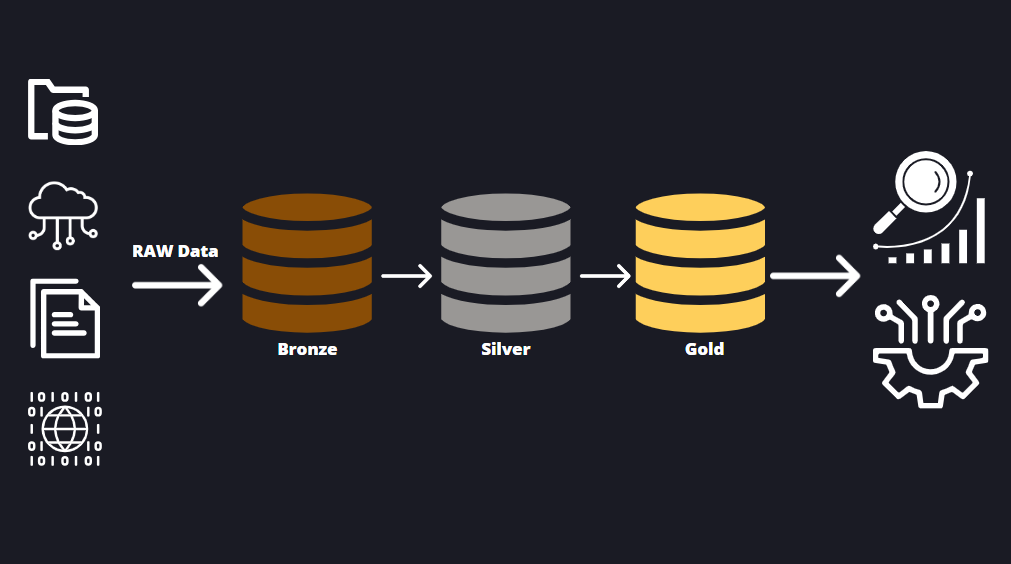
The Medallion Architecture consists of three data tiers:
- Bronze Tier: Raw data
- Silver Tier: Cleaned and validated data
- Gold Tier: Business-ready data
Data moves through these three tiers, from Bronze to Silver to Gold, and the structure of the data is refined at every stage. When it reaches the gold tier, the data should be refined and restructured into a useful data product based on business requirements.
1. The Bronze Tier (Raw Data)
This is where the data journey begins. The bronze layer stores raw data exactly as it comes from various sources like APIs, manual data dumps, and web scraping. It captures data in formats such as CSV, JSON, and logs, and stores it without any modification. This ensures a complete and auditable record of original data, which is critical for traceability and compliance.
A good example is an e-commerce company that collects raw clickstream logs, transaction records, customer interactions, and competitor data from web scraping in the bronze layer. Everything goes in exactly as received, no changes, no cleaning, just pure raw data.
2. Silver Tier (Cleaned and Validated Data)
In the silver layer, the data is processed and transformed to achieve cleaner, more structured data. This involves removing duplicates, filtering out corrupt or incomplete records, standardizing formats, and joining related datasets to create a more reliable dataset. This phase includes defining schema consistency and prepares data for analytical queries.
Here, the e-commerce company cleans the raw logs by removing invalid entries, handles missing customer details, and combines transaction data with customer profiles and competitor data to create a unified dataset. The data is now clean and ready for analysis.
3. Gold Tier (Business-Ready Data)
The gold layer contains data that is fully processed for end-user consumption. In this layer, we perform dimensional modeling, aggregation, and complex calculations to create robust datasets. The data is structured, optimized for fast queries, and enriched to meet specific business needs.
The business aggregates customer spending, calculates sales performance metrics, performs competitor analysis, and generates summaries for executive dashboards. This is the data that business users actually work with to make decisions.
Why This Approach Works
The Medallion architecture gives you several benefits:
Clear Data Lineage: You can always trace back from your business insights to the original raw data, which is crucial for compliance and debugging.
Flexibility: If business requirements change, you can rebuild your gold layer without losing your raw data or having to re-extract from source systems.
Quality Control: Each layer has a specific purpose, making it easier to identify and fix data quality issues at the right stage.
Performance: By the time data reaches the gold layer, it’s optimized for the queries your business actually runs, making reports and dashboards much faster.
Collaboration: Different teams can work with data at the appropriate level, data engineers focus on bronze and silver, while analysts and business users work with gold.
Finally
Start simple. You don’t need to build all three layers at once. Begin with:
- Setting up your bronze tier to capture raw data from your sources
- Creating a tier layer that addresses your data quality issues
- Then build the gold tier datasets that answer your critical business questions
As your needs grow, you can include sophistication to each layer. The key is to maintain the separation between the raw data and transformed data.
The Medallion architecture creates a scalable system that keeps your data trustworthy and useful.